
DVR vs NVR (Analogue vs IP CCTV): Which Is Best for Your Property in 2026?
If you’re looking at getting CCTV installed, you’ll bump into two main options straight away:
-
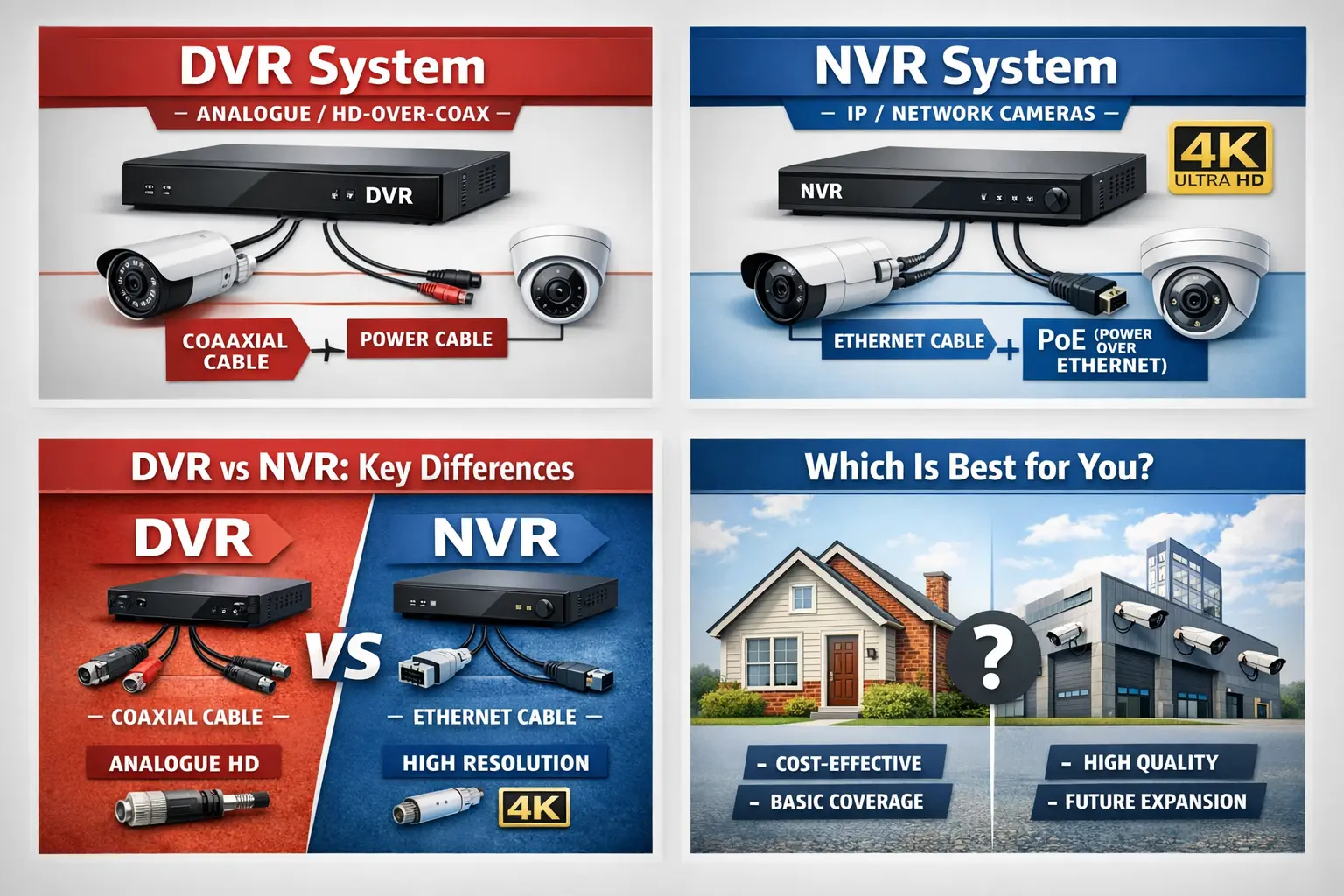
DVR systems (usually paired with analogue / HD-over-coax cameras)
-
NVR systems (paired with IP / network cameras)
Both can be brilliant when they’re designed properly — but they suit different properties, budgets, and expectations. This guide breaks it down in plain English so you can choose the right one first time.
Quick answer (if you’re in a rush)
-
Choose DVR / analogue (HD-over-coax) if you want a cost-effective, reliable system for standard coverage and you already have (or can easily run) coax cable routes.
-
Choose NVR / IP if you want higher detail, more flexibility, smarter features, and easier scaling — especially for larger homes, businesses, warehouses, yards, or sites where future expansion is likely.
What is a DVR system?
A DVR (Digital Video Recorder) records video from cameras connected via coax cable (with power usually run alongside). Modern “analogue” CCTV isn’t the grainy stuff from years ago — most installs now use HD-over-coax (often 4MP / 5MP or even 8MP, depending on kit).
DVR pros
-
Great value for money
-
Simple and reliable
-
Often ideal for small homes / small premises
-
Can be easier for straightforward cable runs
DVR cons
-
Less flexible than IP in some layouts
-
Advanced analytics and smart features can be more limited
-
Upgrading later can mean changing more hardware (depending on the system)
What is an NVR system?
An NVR (Network Video Recorder) records from IP cameras over a network. Cameras connect via Ethernet and often use PoE (Power over Ethernet) — meaning one cable can handle power + data.
NVR pros
-
Higher image quality is common (especially at 4K and above)
-
Flexible expansion (add more cameras later more easily)
-
Better support for smart features (line crossing, intrusion zones, people/vehicle filtering)
-
Often the better choice for business sites and larger installs
NVR cons
-
Usually costs more than DVR for equivalent camera count
-
Network quality matters (good cabling, correct setup)
-
Needs to be installed properly to avoid issues like bandwidth/storage problems
Analogue vs IP CCTV: what’s the real difference?
Think of it like this:
-
Analogue/HD-over-coax (DVR) = traditional wiring approach, modern HD video, strong value
-
IP (NVR) = network-based cameras, higher capability, more scalable
Both record footage to a central recorder. The difference is how cameras connect and what they can do.
Image quality: does IP always win?
Not always — but IP usually wins when detail matters, for example:
-
Reading faces at distance
-
Identifying clothing/vehicles more clearly
-
Covering larger areas without losing usable detail
That said, a well-positioned 5MP/8MP HD-over-coax system can still look excellent for typical home coverage (driveway, back garden, side gate).
The biggest “quality” factor is often camera placement, lens choice, and lighting — not just the resolution.
Cabling: coax vs ethernet (PoE)
DVR cabling (coax)
-
Typically coax for video
-
Separate power (or a combined cable depending on system)
-
Great for traditional routes and many domestic installs
NVR cabling (ethernet / PoE)
-
One cable (Cat5e/Cat6) can do power + data via PoE
-
Cleaner installation in many situations
-
Better for longer-term scalability
Storage & retention (how many days you keep footage)
Both DVR and NVR systems can be set up for decent storage — it depends on:
-
Number of cameras
-
Resolution (1080p vs 4MP vs 4K)
-
Frame rate
-
Compression settings
-
Motion recording vs 24/7 recording
-
Hard drive size
Typical retention is often 7–30 days, but it can be designed around what you actually need.
Remote viewing: both can do it — but setup matters
Both systems usually support app viewing, playback, and notifications.
The difference is: IP systems can be more network-heavy and benefit from correct configuration (secure passwords, firmware updates, good Wi-Fi or hardwired network, etc.).
Smart features: line crossing, intrusion zones, people/vehicle filtering
If you want:
-
Alerts when someone enters a zone
-
Filtering to reduce false alerts (cats, trees, headlights)
-
Vehicle vs person detection
-
Perimeter-style rules (great for yards/outbuildings)
…then NVR/IP systems are usually the better platform.
Which is best for homes?
Most homes in Hull and surrounding areas tend to fall into one of these:
Best fit for DVR / analogue (HD-over-coax)
-
2–6 camera installs
-
Straightforward coverage (front/back/side)
-
You want solid footage without going overboard on budget
Best fit for NVR / IP
-
Larger houses / wider plots
-
You want higher detail for identification
-
You want smart alerts and reduced false triggers
-
You want something you can expand later
Which is best for businesses?
For most businesses, NVR/IP is the default recommendation, especially if:
-
You need higher detail at distance
-
You want smart detection and event search
-
You’ll likely expand (more cameras, more coverage)
-
You have multiple buildings/areas to cover
But for some smaller shops or straightforward sites, DVR can still be a cost-effective win.
Cost: is analogue always cheaper?
Often, yes — but not always.
Costs can swing based on:
-
Camera type (standard vs colour night vision, varifocal lenses, PTZ)
-
Cable routes (easy route vs complicated building)
-
Height/access equipment
-
Storage requirements
-
Monitoring needs
If you want a realistic ballpark, your cost of CCTV installation guide is the next best read.
What we recommend (simple, honest)
If you tell us:
-
What you’re protecting (home/shop/yard/warehouse)
-
The areas you want covered
-
Whether you need smart alerts
-
Whether internet is strong/weak on-site
-
Whether you want future expansion
…we can advise what fits best — and we’ll design it properly so it performs in real life (not just on paper).
You can visit our CCTV installation or maintenance page for more information.
FAQs
No. HD-over-coax systems are still widely used and can look very good. It’s not “old CCTV” — it’s a different platform.
Sometimes. Some recorders are “hybrid”, but mixing systems isn’t always the cleanest option. It depends what you’re trying to achieve.
Usually NVR/IP is easier to scale, especially if the network is planned properly from the start.
You don’t need internet for recording, but you typically need it for remote viewing and app notifications.
Reviewed: 04/01/2026 Our articles are reviewed regularly. However, any changes made to standards or legislation following the review date will not have been considered. Please note that we provide abridged, easy-to-understand guidance. To make detailed decisions about your security provisions, you might require further advice or need to consult the full standards and legislation.
Share this article

Written by : Michael Winter
Follow us
A quick overview of the topics covered in this article.
Latest articles
March 30, 2026

March 30, 2026