
Choosing the Right Commercial Fire Alarm System for Your Business
Choosing the right fire alarm system for your business isn’t simply a case of picking the cheapest option or the one a supplier happens to recommend. The type of system your premises needs depends on the size of your building, how it’s used, how many people occupy it, and what level of protection your insurer and local fire risk assessment requires.
This guide explains the three main types of commercial fire alarm systems — conventional, addressable, and wireless — what each one is best suited to, and how to decide which is right for your business. If you’re at the point of specifying a system, it’s also worth reading our guide to BS 5839 fire alarm standards which underpins all commercial fire alarm design and installation in the UK.
The three main types of commercial fire alarm systems
Conventional fire alarm systems
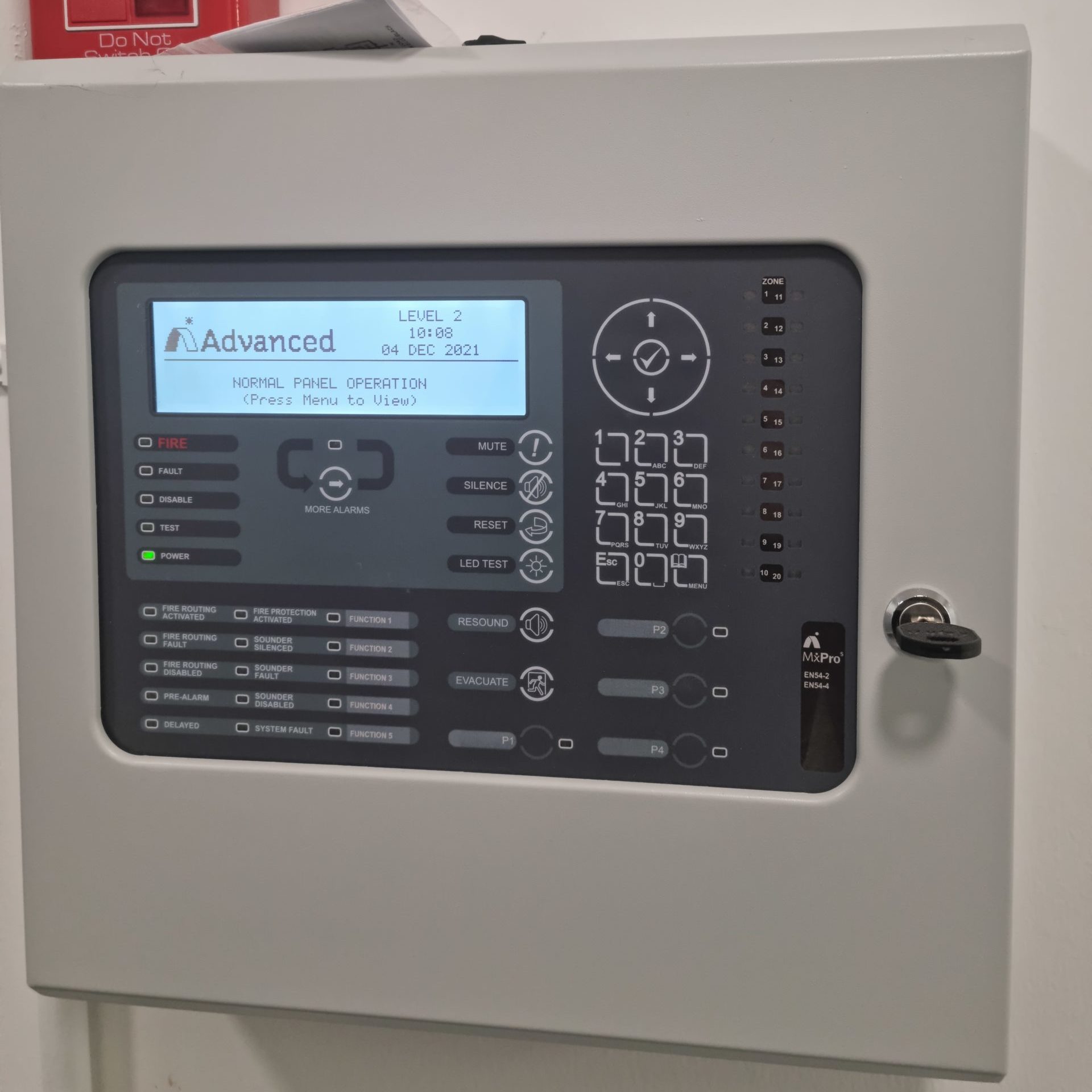
A conventional fire alarm system divides a building into a number of zones, each wired back to the main control panel. When a detector or call point is triggered, the panel identifies which zone the activation came from — but not the specific device.
Best suited to: Smaller commercial premises with a straightforward layout. Single-storey units, small offices, workshops, retail units, and light industrial premises where the zone information alone is sufficient to locate a fire quickly.
How it works in practice: If a smoke detector in your storeroom triggers the alarm, the panel will show “Zone 3 — Rear of Building” or similar. A member of staff or the attending fire service then knows which area to check. In a small building this is perfectly adequate. In a large or complex building, it isn’t.
Advantages: Lower installation cost than addressable systems. Straightforward to maintain. Well understood by engineers across the industry.
Limitations: In larger buildings with multiple rooms per zone, identifying the exact source of an alarm takes longer. False alarm management is also more difficult since you can’t pinpoint which specific device activated.
Addressable fire alarm systems
An addressable system gives every single detector, call point, and sounder its own unique address on the network. When any device activates, the control panel identifies it precisely — not just which zone, but which specific device on which floor in which room.
Best suited to: Medium to large commercial premises. Multi-storey offices, warehouses, schools, care homes, hotels, hospitals, and any building where rapid identification of the fire source is critical to a fast and safe evacuation.
How it works in practice: Rather than “Zone 3 — Rear of Building,” the panel displays “Smoke Detector — Room 14, Second Floor, East Wing.” The response is faster, more targeted, and significantly reduces the risk of unnecessary full building evacuations in the case of a false alarm.
Advantages: Precise fault and activation location. Better false alarm management — devices can be investigated individually before a full evacuation is initiated where appropriate. Easier to expand or modify as your premises changes. Detailed event logging for post-incident review and compliance purposes.
Limitations: Higher installation cost than conventional. More complex to commission and maintain, so requires a competent engineer familiar with the specific panel manufacturer.
For most medium and large businesses in Hull and East Yorkshire, an addressable system is the right long-term investment. Our commercial fire alarm installation service covers both conventional and addressable systems, designed and installed to BS 5839-1:2025.
Wireless fire alarm systems
A wireless fire alarm system uses radio frequency communication between devices rather than hardwired cable runs. Each detector, call point, and sounder communicates wirelessly with the control panel, removing the need to run cables through walls, ceilings, and floors.
Best suited to: Listed buildings or heritage properties where drilling and cable routing would cause damage. Temporary premises or sites where the layout changes frequently. Buildings where a wired installation would be impractical or prohibitively expensive due to the structure.
How it works in practice: Devices are battery-powered and communicate via a monitored radio signal. Most modern wireless systems are fully supervised, meaning the panel detects if a device loses communication or if a battery is running low. The result is functionally very similar to a wired addressable system.
Advantages: Minimal disruption during installation — no chasing, no cable runs, no redecoration. Ideal for occupied premises where downtime needs to be minimised. Highly flexible for buildings with unusual layouts or restricted access.
Limitations: Battery-powered devices require more regular maintenance checks than hardwired alternatives. Wireless systems are generally more expensive upfront than equivalent wired systems. Not suited to environments with significant radio frequency interference.
Which type of commercial fire alarm system do you need?
The honest answer is that the right choice depends on a proper fire risk assessment of your specific premises — there’s no universal answer that applies to every business.
That said, as a general guide:
Small commercial premises (single storey, simple layout, low occupancy): A conventional system will almost certainly be adequate and represents the most cost-effective solution.
Medium to large commercial premises (multi-storey, complex layout, higher occupancy): An addressable system is almost always the right choice and is increasingly expected by insurers and fire risk assessors for premises of this type.
Heritage, listed, or temporary premises: A wireless system is worth serious consideration, particularly where a wired installation would cause structural damage or require extensive redecoration.
Mixed-use or complex sites: Some premises benefit from a hybrid approach — addressable as the core system with wireless devices in areas where cabling is impractical.
Understanding the BS 5839 fire alarm categories — L1, L2, P1, P2, and M — is also important at this stage, as these define the extent of detection coverage required, not just the type of equipment used.
What the law requires
All commercial fire alarm systems in the UK must comply with the Regulatory Reform (Fire Safety) Order 2005, which places a legal duty on the Responsible Person — usually the business owner, employer, or building manager — to ensure adequate fire detection and warning is in place.
In practice, this means:
- A fire risk assessment must be carried out and reviewed regularly
- The fire alarm system must be appropriate for the premises and its occupants
- The system must be installed and maintained to BS 5839-1:2025 by a competent person
- Records of installation, testing, and maintenance must be kept
Our fire alarm maintenance service keeps your system compliant with BS 5839-1:2025, with planned servicing visits, clear reports after every visit, and full logbook updates — so you’re covered for inspections, audits, and insurance requirements.
Should you have your fire alarm monitored?
Whichever type of system you choose, one additional question worth considering is whether to have it connected to a 24/7 Alarm Receiving Centre (ARC) for remote monitoring.
A monitored system means that if your alarm activates when the building is unoccupied — overnight, at weekends, or during a holiday closure — the ARC is notified immediately and can contact keyholders or the fire brigade on your behalf. For many commercial premises this isn’t optional — it’s required by their insurer or written into their fire risk assessment.
Our fire alarm monitoring service is NSI Gold accredited and connects your system to a professional ARC that operates around the clock. It can be added to both new installations and existing systems in most cases.
Commercial fire alarm installation in Hull and East Yorkshire
Cobra Fire and Security designs and installs commercial fire alarm systems for businesses across Hull, Beverley, Goole, Scunthorpe, Cottingham, and the surrounding areas. We’re SSAIB accredited, and every system we install is designed to BS 5839-1:2025 following a site survey and fire risk assessment review.
Whether you’re fitting out a new commercial premises, replacing an outdated system, or unsure whether your current system meets current standards, get in touch with our team for a free site survey. We’ll advise you on the right system type for your building, provide a clear written quote, and handle the full installation with minimal disruption to your operations.
Frequently asked questions
A conventional system identifies which zone a fire has been detected in. An addressable system identifies the exact device that has activated, giving you precise location information. Addressable systems are better suited to larger or more complex buildings.
The Regulatory Reform (Fire Safety) Order 2005 requires the Responsible Person to ensure adequate fire detection is in place. For most commercial premises this means installing a fire alarm system. The specific type required depends on your fire risk assessment.
Under BS 5839-1:2025 most commercial systems should be serviced at approximately six-month intervals. Some larger or higher-risk sites benefit from quarterly visits. Every service should be documented in your fire alarm logbook.
Yes. A wireless fire alarm system is usually the preferred solution for listed or heritage buildings as it requires no cable routing and causes no structural damage during installation.
Yes. We regularly take over fire alarm maintenance contracts from other providers. We carry out an initial inspection to assess the system’s condition and compliance before starting a maintenance agreement.
Reviewed: 05/05/2026 Our articles are reviewed regularly. However, any changes made to standards or legislation following the review date will not have been considered. Please note that we provide abridged, easy-to-understand guidance. To make detailed decisions about your fire safety provisions, you might require further advice or need to consult the full standards and legislation.
Share this article

Written by : Michael Winter
Follow us
A quick overview of the topics covered in this article.
Latest articles

October 21, 2026
October 21, 2026