
What Does a Fire Alarm System Cost for an HMO in Hull?
HMO fire alarm installation cost is one of the most common questions we get from landlords across Hull and East Yorkshire — and it’s a fair one, because getting it wrong is expensive in both directions. Underspend and you risk non-compliance, failed licensing inspections, and potential liability. Overspend on a system your property doesn’t need and you’ve wasted money that could go elsewhere.
This guide gives Hull landlords a clear picture of what HMO fire alarm installation costs, what drives those costs up or down, and what grade of system your property actually needs under current UK standards. If you want to understand the technical standards behind these requirements in more detail, our BS 5839-6 guide covers the grades and categories in full.
What grade of fire alarm does your HMO need?
Before looking at costs, it’s worth understanding that not all HMOs need the same level of system. The grade required depends primarily on the size of your property and the number of storeys. Getting this right is the foundation of everything else — the grade determines the equipment, which determines the cost.
One and two storey HMOs
For HMOs with one or two storeys where the individual floor area doesn’t exceed 200sqm, BS 5839-6 recommends a Grade D, Category LD3 system. This means mains-powered smoke and heat alarms with a built-in battery backup, interconnected so that when one triggers, they all sound.
These are not commercial fire alarm panels — they’re interlinked detector systems, similar to domestic smoke alarms but to a higher specification. This is the most straightforward and most affordable type of HMO fire alarm installation.
Three storey HMOs and above
For HMOs with three or more storeys, the requirements increase significantly. You have two options under BS 5839-6:
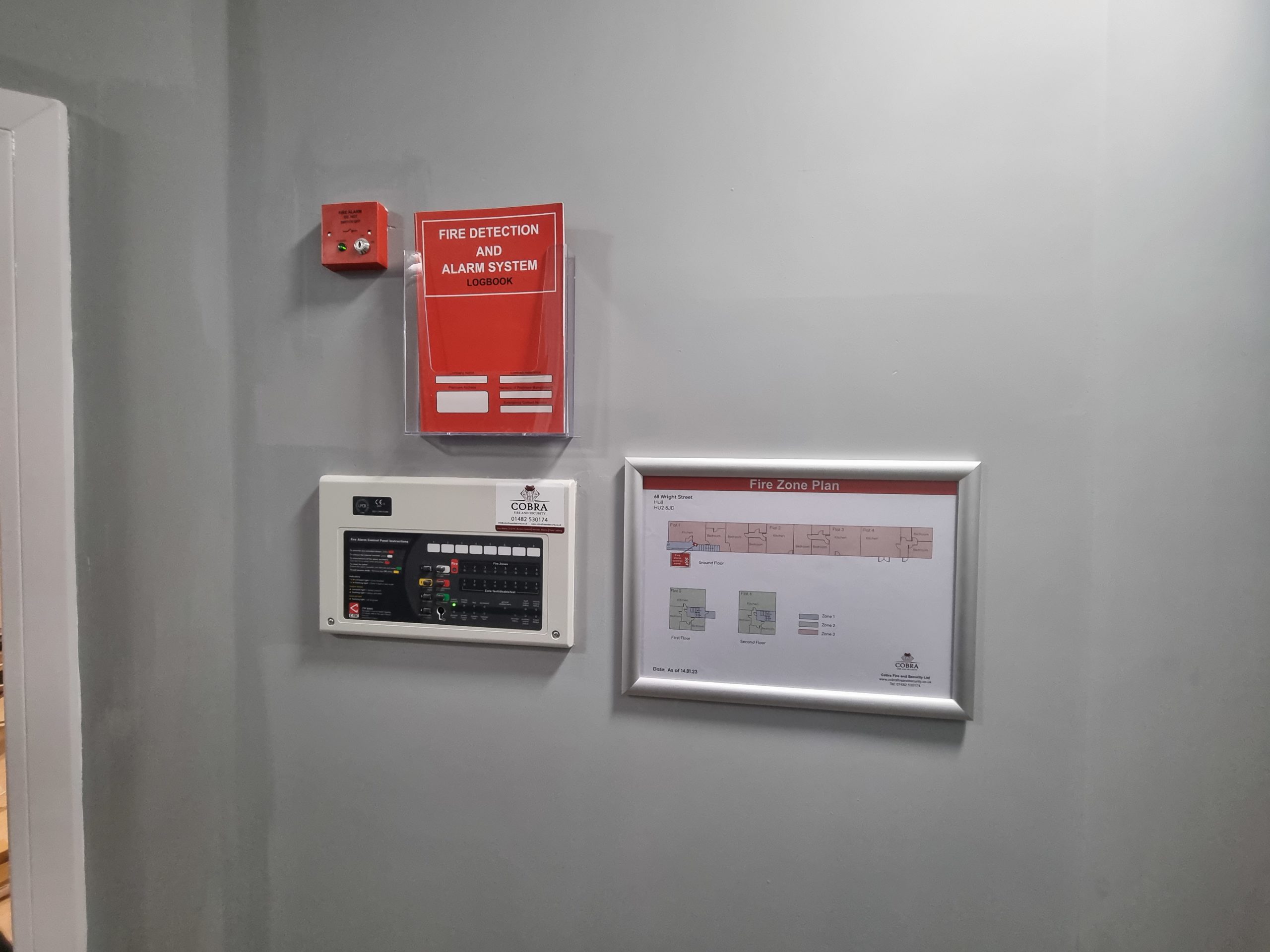
Option 1 — Grade A system throughout: A full commercial-grade fire alarm panel with detectors, call points, sounders, and beacons specified across the entire building. This is the more comprehensive solution and is increasingly preferred by local licensing authorities.
Option 2 — Mixed system: A Grade D, LD3 system within individual flats or bedrooms, combined with a separate Grade A system covering all communal areas — hallways, stairwells, landings, and kitchens. This approach is growing in popularity because it reduces the impact of nuisance alarms from individual units affecting all residents.
For larger or more complex HMOs, it’s also worth reading about HMO fire regulations to understand the broader compliance picture beyond just the alarm system itself.
HMO fire alarm installation costs in Hull and East Yorkshire
With the grade requirements in mind, here’s a realistic breakdown of what to expect to pay for HMO fire alarm installation in the Hull area. All prices are guide figures plus VAT and assume a standard property without unusual access requirements or significant remedial electrical work.
Grade D interlinked system (1-2 storey HMO)
A straightforward Grade D installation in a typical two-storey HMO with three to four bedrooms will usually fall in the range of £300–£600 + VAT depending on the number of detectors required, whether existing wiring can be reused, and the complexity of the interconnection.
Mains-powered interlinked alarms are now the standard expectation from most local authorities. Radio-interlinked alarms with 10-year sealed batteries are also increasingly accepted, particularly in retrofit situations where running mains wiring would be disruptive — these can be slightly more expensive upfront but avoid the need for an electrician to run new cable.
Grade A system (3+ storey HMO)
A Grade A addressable or conventional panel system for a three-storey HMO will typically cost between £1,500–£4,000 + VAT for the installation alone, depending on the number of floors, rooms, and devices required.
The wide range reflects the genuine variation in HMO layouts — a three-storey converted house with six bedrooms and shared communal areas is a very different job from a purpose-built block of self-contained flats. A site survey is the only reliable way to get an accurate figure.
Mixed system (Grade D in flats + Grade A in communal areas)
For landlords of larger HMOs who want to minimise disruption to tenants while meeting Grade A requirements in communal areas, a mixed system is often the most cost-effective approach. Expect costs in the range of £1,200–£3,000 + VAT depending on the size of the communal areas and whether a new panel is required.
What drives the cost up?
Several factors can push HMO fire alarm installation costs above the guide figures above:
Age and condition of the property — Older properties often require additional work to route cables or bring existing electrical infrastructure up to a standard that can support mains-powered detectors. Properties with solid walls, complex roof structures, or limited ceiling void access take longer to install.
Number of individual units — The more separate bedrooms or self-contained flats in the HMO, the more devices are required and the longer the installation takes.
Existing system condition — If there’s an old system already in place that needs to be removed or assessed before the new installation can begin, this adds time and cost.
Local authority requirements — Hull City Council’s HMO licensing conditions can specify requirements beyond the minimum BS 5839-6 recommendations. In some cases, a Grade A system may be required for a property that would technically qualify for a lower grade under the standard. Always check your licence conditions.
Emergency lighting — Many HMO licensing authorities also require emergency lighting in communal areas. If this needs to be installed at the same time, it adds to the overall project cost but is often more cost-effective to do in a single visit.
Ongoing maintenance costs
Installation is a one-off cost, but fire alarm maintenance is a recurring obligation. Under BS 5839-6, HMO fire alarm systems should be inspected and tested at regular intervals — annually as a minimum for Grade D systems, and at six-monthly intervals for Grade A systems.
As a guide for Hull landlords:
- Grade D annual inspection: £80–£150 + VAT for a standard HMO
- Grade A six-monthly service visits: £150–£300 + VAT per visit depending on system size
Beyond professional servicing, you or your managing agent should be carrying out a weekly alarm test and keeping a record in your fire alarm logbook. Our fire alarm maintenance service covers both Grade D and Grade A HMO systems across Hull and East Yorkshire, with clear written reports after every visit to support your licensing inspections.
Do you need fire alarm monitoring for an HMO?
Monitoring — where your alarm is connected to a 24/7 Alarm Receiving Centre that can alert the fire brigade if the alarm activates when the property is unoccupied — is not a legal requirement for most HMOs.
However, it is worth considering if your HMO has periods where no tenants are present, or if your insurer requires it as a condition of cover. Some landlords with larger portfolios also find that monitored systems reduce the burden of being called out personally in the middle of the night for a false alarm. Our fire alarm monitoring service covers HMOs across Hull and East Yorkshire and can be retrofitted to most existing systems.
HMO fire alarm installation in Hull and East Yorkshire
Cobra Fire and Security installs and maintains HMO fire alarm systems for landlords across Hull, Beverley, Cottingham, Goole, Scunthorpe, and the surrounding areas. We’re SSAIB accredited, and all our installations are carried out to BS 5839-6 with full documentation provided — including installation certificates, system drawings, and logbook setup — so you have everything you need for your HMO licence application or renewal.
If you’re unsure what grade of system your property needs, or you want a clear written quote before committing, get in touch for a free site survey. We’ll assess your property, advise on the most cost-effective compliant solution, and provide a fixed price before any work begins.
Frequently asked questions
For a one or two storey HMO, a Grade D interlinked system typically costs £300–£600 + VAT. For three storey and above properties requiring a Grade A system, costs are usually £1,500–£4,000 + VAT depending on the size and layout of the property.
This depends on the number of storeys and the floor area of your property. One and two storey HMOs under 200sqm per floor typically need a Grade D, LD3 system. Three storey and above properties need either a full Grade A system or a mixed Grade D/Grade A system. Your HMO licence conditions may also specify requirements above the minimum standard.
There’s no absolute legal requirement, but most local authority HMO licensing conditions expect fire alarm systems to be installed by a competent person to BS 5839-6. Using an BAFE accredited installer provides the strongest evidence of compliance and is expected by most insurers.
Grade D systems should be professionally inspected annually at minimum. Grade A systems should be serviced every six months in line with BS 5839-6. Weekly testing and logbook entries are also required regardless of system grade.
Yes. We regularly upgrade older or non-compliant systems as part of HMO licence applications or renewals. We’ll carry out an initial inspection, advise on what’s needed to bring the system up to the required standard, and provide a fixed quote before any work starts.
Reviewed: 05/05/2026 Our articles are reviewed regularly. However, any changes made to standards or legislation following the review date will not have been considered. Please note that we provide abridged, easy-to-understand guidance. To make detailed decisions about your fire safety provisions, you might require further advice or need to consult the full standards and legislation.
Share this article

Written by : Michael Winter
Follow us
A quick overview of the topics covered in this article.
- What Does a Fire Alarm System Cost for an HMO in Hull?
- What grade of fire alarm does your HMO need?
- HMO fire alarm installation costs in Hull and East Yorkshire
- What drives the cost up?
- Ongoing maintenance costs
- Do you need fire alarm monitoring for an HMO?
- HMO fire alarm installation in Hull and East Yorkshire
- Frequently asked questions
Latest articles

October 21, 2026
October 21, 2026